
The rules of options exercises can get confusing, make sure you understand the risk, cautions Alan Ellman.
When we sell covered calls or cash-secured puts, we understand that if a strike ends up in-the-money at expiration, that option will be exercised over the weekend and shares will be sold or purchased depending on the option type (for calls, our shares are sold; for puts, new shares are purchased with the cash set aside in our account).
On April 5, 2019, a subscriber wrote to me about a cash-secured put he sold with an expiration date of April 5. At 4 PM EDT on expiration Friday the strike was out-of-the-money (OTM), but the put was exercised over the weekend and Daniel (my subscriber) was baffled as to why this occurred.
Daniel’s trade
Daniel sold a Weekly $390 put for The Boeing Co. (BA) with an expiration on April 5, 2019. At 4 PM on that date, BA was trading at $391.93, leaving the sold put strike $1.93 OTM seemingly safe from exercise. The next day, Daniel checked his brokerage account and noticed that he now owned BA and the cash set aside in his brokerage account for this trade was gone. What happened?
The mechanics of exercise
OTM strikes are almost never exercised. In this case, why would a market professional (like a market-maker) want to sell BA for $390 when it is currently trading at $391.93? The market-maker has 90 minutes after market close to inform the Options Clearing Corporation (OCC) as to what action, if any, they want regarding their long option position: Allow the option to expire worthless or exercise the option.
Let’s go back to 4 PM ET on April 5th
BA announced that it would cut back production of its 737 Max jets after two fatal crashes. This news was published in the 90-minute window after market closed and when market-makers had to notify the OCC regarding action on their long puts. It was obvious at this point that share price would likely decline by market open on Monday leaving the now OTM put in-the-money the following week. Exercise would benefit long put holders and put those with short positions at risk.
Below is the BA chart showing price decline between April 5 and April 8.
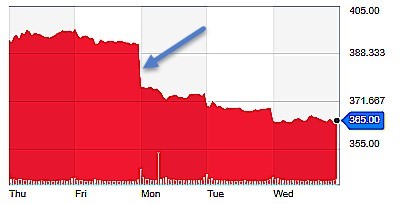
BA: After-Hours Price Decline
On Monday April 8, BA was trading at $377, creating an unrealized loss of $13 per share for Daniel. On the surface, this does not seem fair, but it is the nature of how trading occurs and the risks that both market-makers (they are required to take positions) and retail investors (risk on unexpected bad news) undertake.
How could this have been avoided
Most of us would have taken no action as did Daniel. But, if we wanted to avoid any chance of bad news coming out in that 90-minute window, we could have closed the options prior to 4 p.m. EDT. Since there was virtually no time value remaining, it would have been pennies per share plus small trading commissions to do so. These events are quite rare but do hurt. So how do we determine if we should close? In this case, BA has been in the news quite frequently after the two crashes and so there was risk with this stock and the potential of negative news. Conservative investors may have considered closing and then “getting out of Dodge” with a new stock the following week.
Discussion
There is assignment risk with OTM strikes if news comes out (positive or negative) in the 90-minute window after market closes on expiration Friday. A stock that has been generating an unusual amount of significant news is particularly susceptible. On a similar note, pinning the strike is another reason unexpected assignment may occur.
FREE Beginner’s Corner Tutorial for Covered Call Writing has Been Enhanced and Updated here:
Use the multiple tab of the Ellman Calculator to calculate initial option returns (ROO), upside potential (for out-of-the-money strikes) and downside protection (for in-the-money strikes). The breakeven price point is also calculated.